More Information
As a UCLA alumnus who graduated in 2021, I was very happy to return for a 2025 summer internship with the wonderful staff of UCLA Library Preservation & Conservation. It was a joy to learn from Nicole Alvarado and Chela Metzger, two conservators I have long admired. I am so grateful for the time I spent in the lab, where everyone was exceedingly generous with their time and knowledge.
During my internship, items I worked on included Mexican legal documents, an Urdu manuscript, architectural drawings, and rolled panoramic photographs. However, materials from the Children's Books Collection(opens in a new tab) were my favorite to spend time with. With items primarily from the 18th- and 19th-centuries, these books fit into my personal research interest in the evolution of modern mass media and popular literature.
As I return to grad school, looking over such a varied assortment of cloth-covered books has influenced my Master’s Project, which involves a technical study of select 19th-century cloth-covered books.
A Short-lived Binding Technique
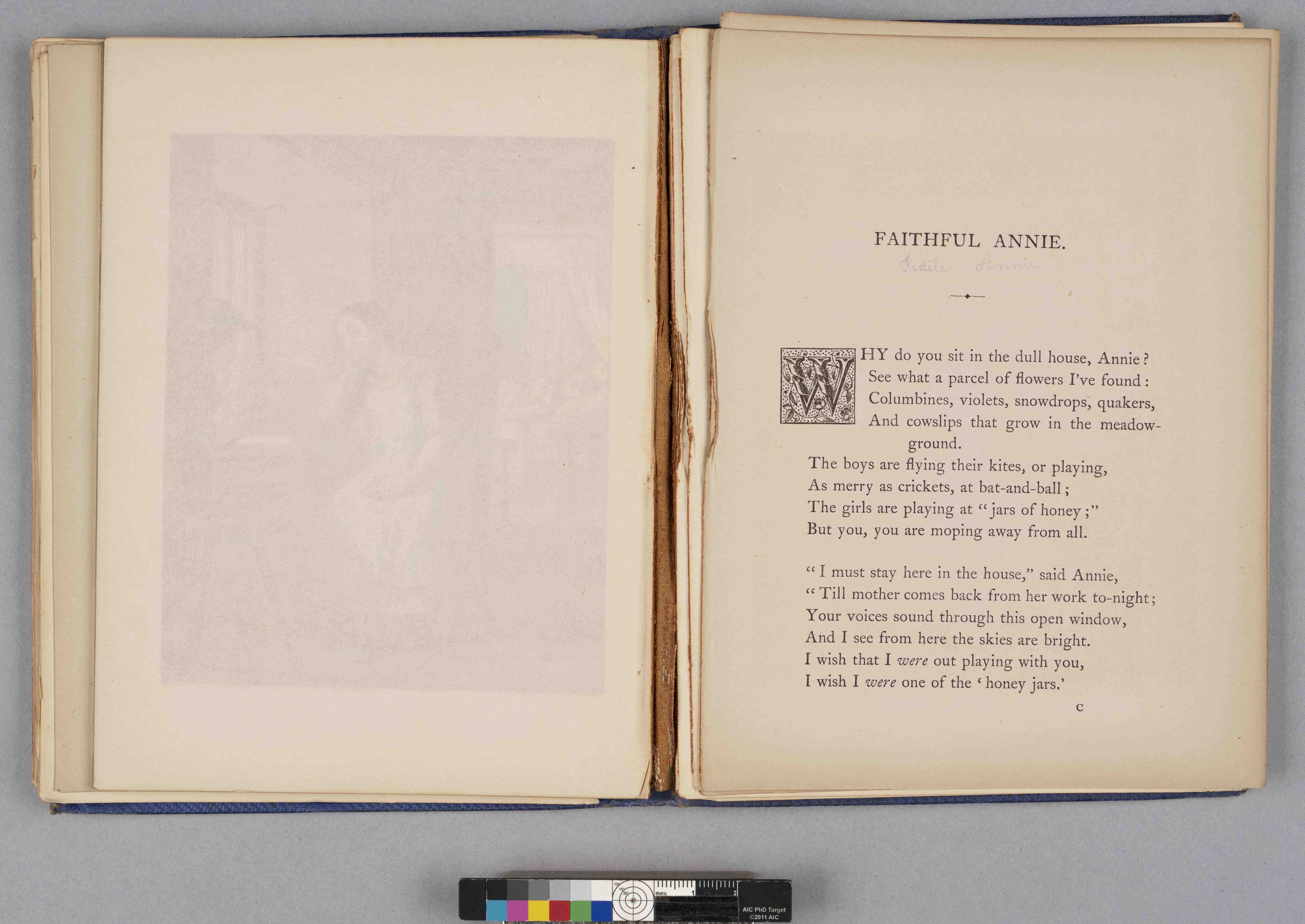
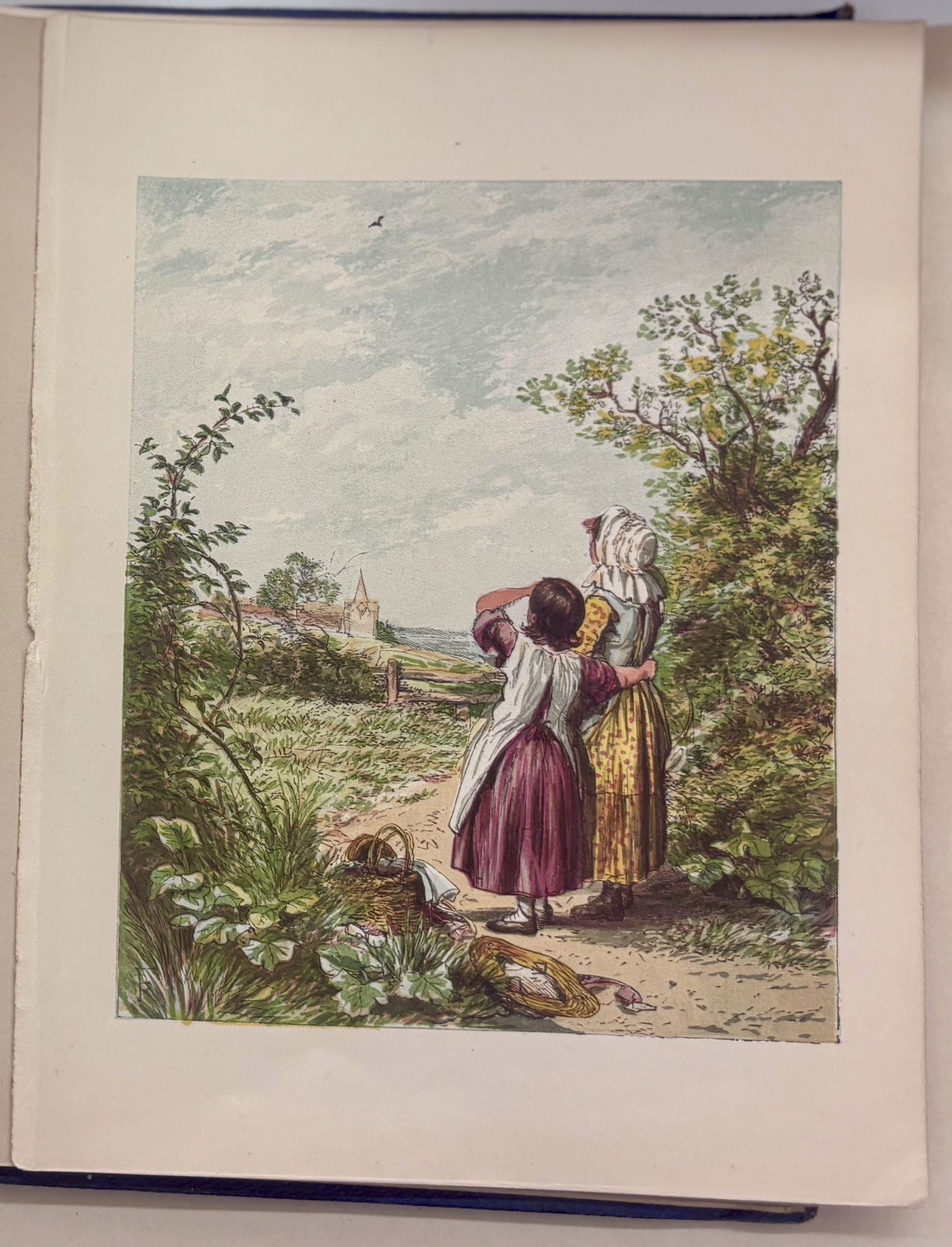
One noteworthy book I worked on, Songs for the Little Ones at Home(opens in a new tab) (1860), is a decorative book with sixteen chromolithographic illustrations.
This book is an example of an early form of adhesive binding where, instead of being sewn through folds in the paper, the book was formed by applying a solution of caoutchouc (natural rubber) to the back of stacked, individual leaves of paper. This use of caoutchouc is essentially rubber cement, with the adhesive setting as the solvent carrier evaporates. This binding style was only in use between the 1840s and 1860s, however, as the rubber embrittled rapidly.
Today, most caoutchouc bindings in collections have fallen apart, and many have been rebound into a different format. Having just spent time reading about them, I was inordinately excited to find that there was an untreated example in the lab for stabilization.
Victorian Gift Books and Chromolithography
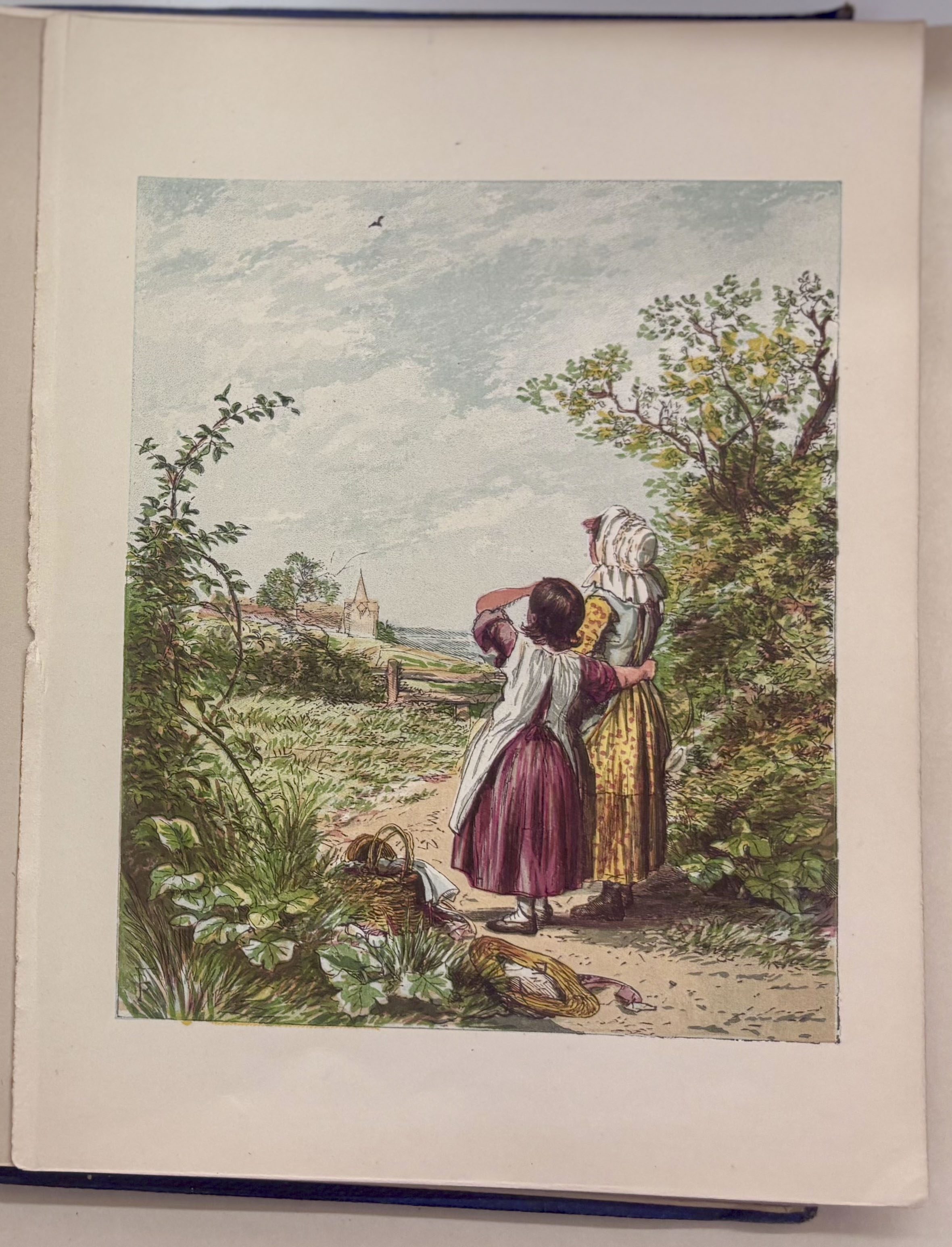
During the 19th century, technological advancements in printing allowed books with multiple image plates to become more affordable. Combined with embossed decorative bookcloth, color illustrations became a feature of Victorian “gift books” designed for middle-class audiences.
Chromolithographs, color prints made through a complex lithographic process, were printed on individual leaves of thick paper separate from the main text. Traditionally, these individual illustration plates were tipped in with interleaving sheets and sewn into a textblock. This time-consuming process was not ideal for affordable and mass-produced publishers’ bindings.
Caoutchouc bindings offered publishers a faster alternative, as text folia folds could be trimmed to create a textblock composed of single leaves. The physical flexibility of natural rubber was considered an additional benefit, allowing the book to open flat and grant greater access for viewing the chromolithographs. The flexibility, however, would prove short-lived.
This natural polymer is very susceptible to oxidation, resulting in embrittlement and reddish, crumbly degradation. With the failure of the adhesive, the textblock comes apart and red powder readily breaks away as the book is handled. Sue Donovan’s chapter on caoutchouc bindings, cited below, gives a much more expansive description of the format’s history and materiality.
Conservation Approach
There are a few possible approaches to stabilizing a caoutchouc binding, each involving different degrees of intervention. From the American Institute for Conservation’s Book and Paper Group Wiki entry on caoutchouc bindings, I learned that conservator Gary Frost developed an approach in 1973, which was never published.
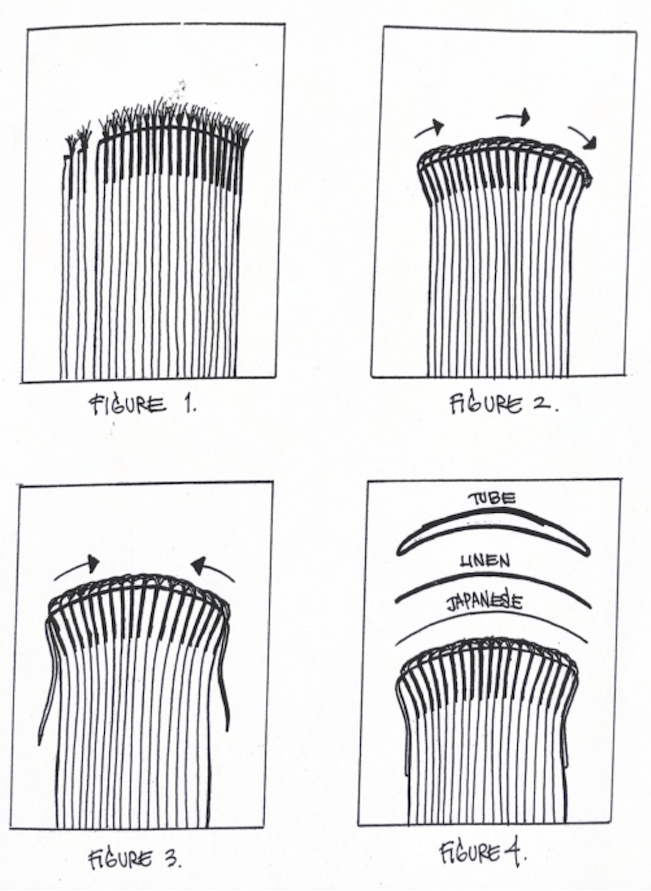
Fortunately, Chela had a copy of his typewritten manuscript I could access.
Frost’s method introduces a paper guard to each leaf and adheres each spine extension to that of a subsequent leaf, resulting in a solid and reversible adhesive binding. Moreover, Frost’s technique offers a level of reversibility and retains evidence of the natural rubber.
Because caoutchouc bindings are so unique and now relatively scarce, I wanted to pursue an approach that allows the book to be handled safely while complementing the original design of the format.
Although Songs for the Little Ones at Home was only one book in a larger batch stabilization project, I am grateful that Chela and Nicole encouraged me to pursue this fairly involved treatment.
The Treatment
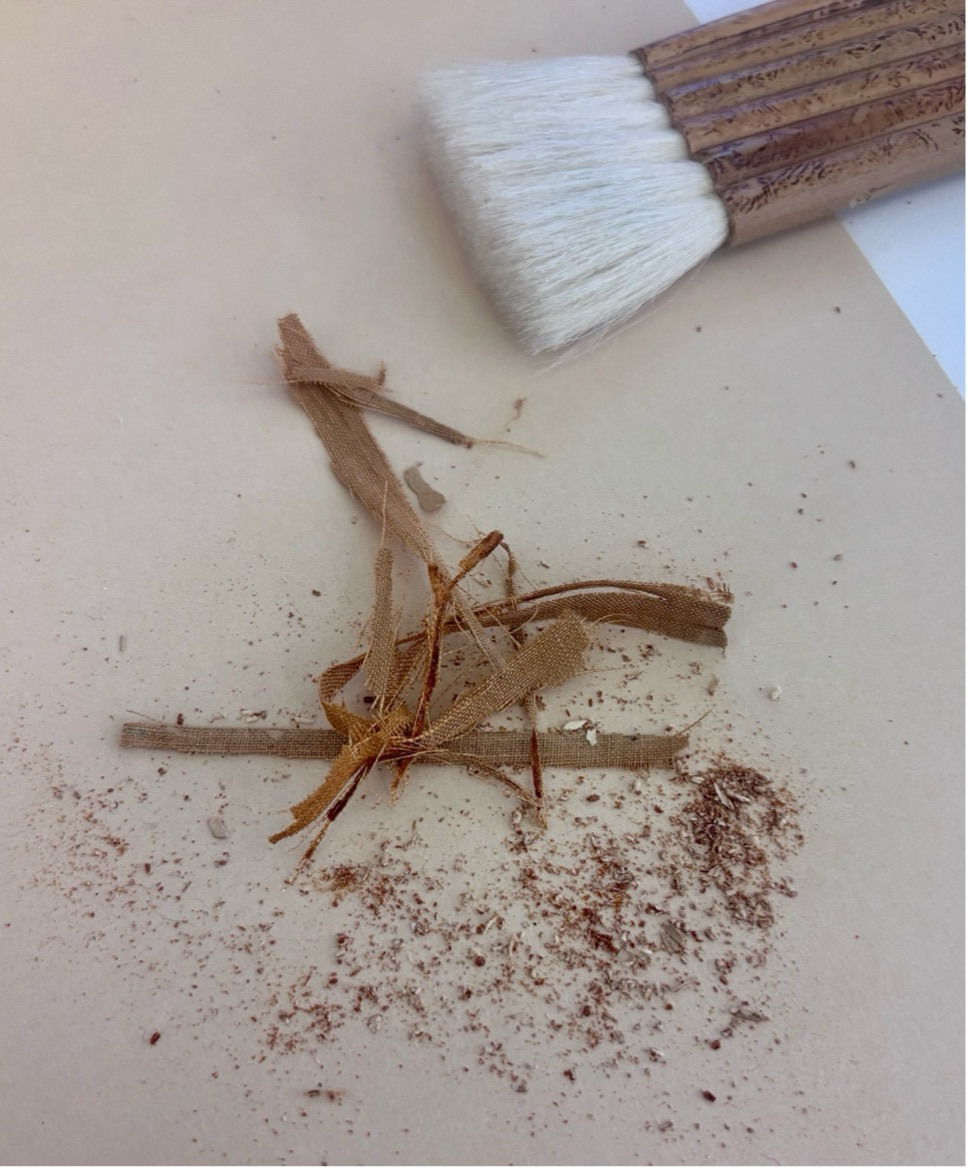
Treatment began by using sandpaper to reduce the bulk of the degraded adhesive from the spine of the textblock, freeing the individual leaves. I further reduced the friable adhesive by running each leaf between my fingernails (Nicole’s suggestion), not attempting to remove caoutchouc that was still firmly attached.
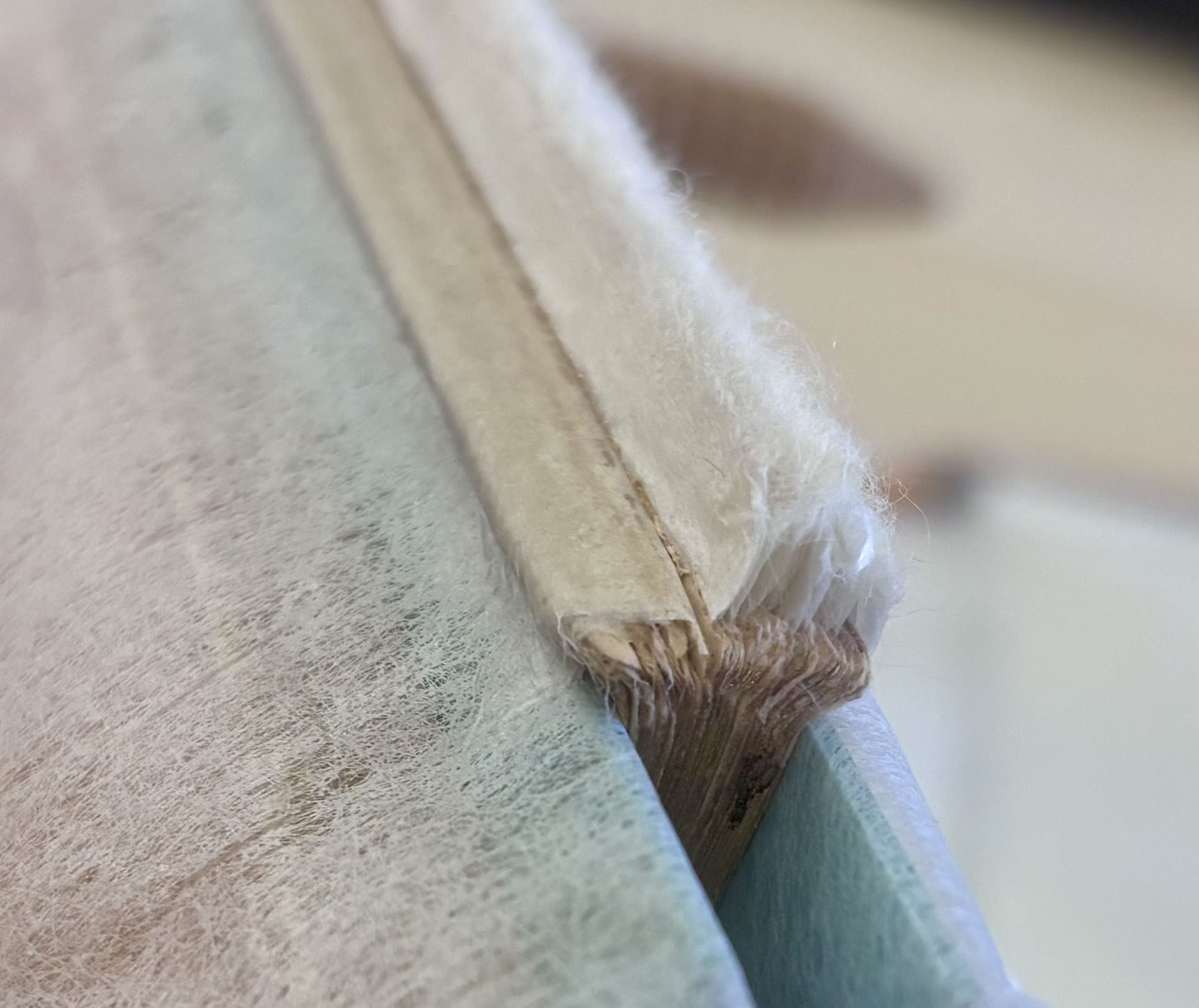
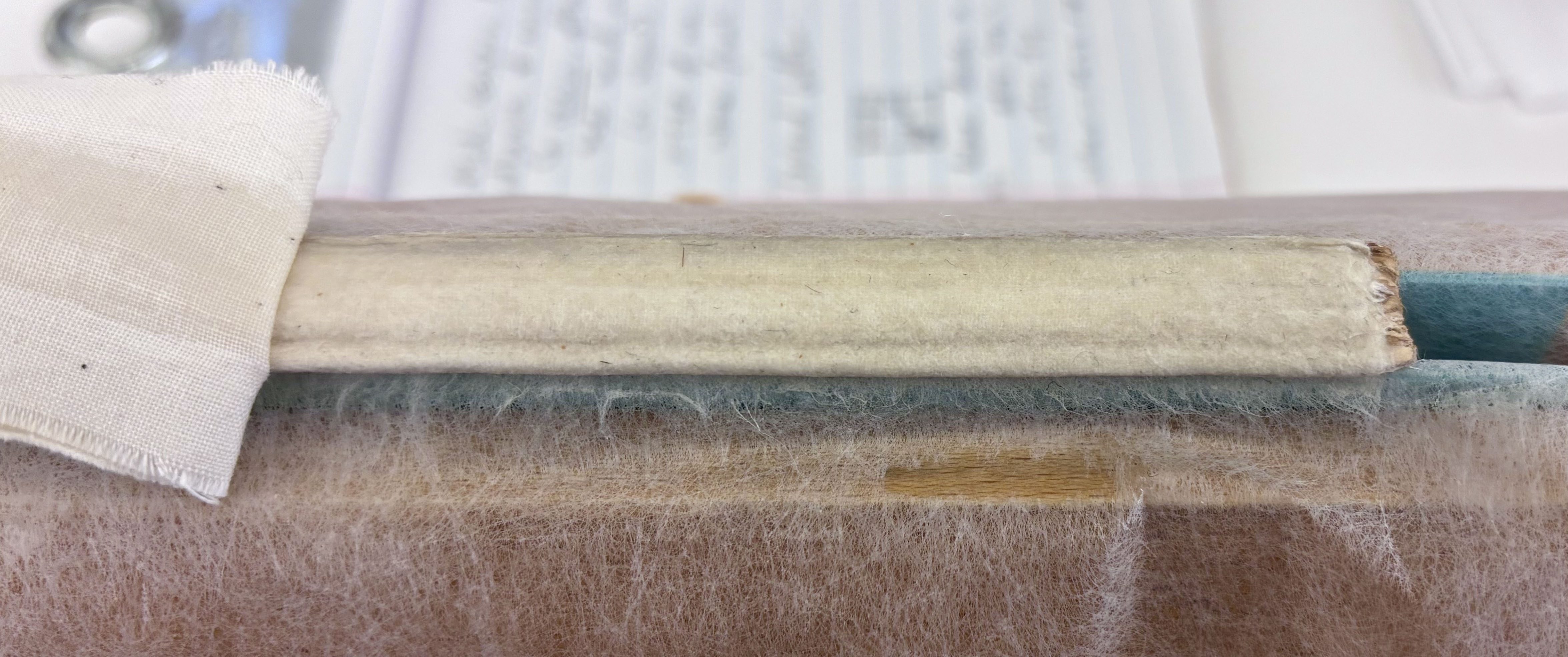
After repairing tears in the textblock, I adhered a guard to each leaf with a blend of wheat starch paste and methyl cellulose. I reshaped the textblock and adhered each leaf with the same aqueous adhesive blend before applying a linen transverse spine lining.
Once the textblock was back in one piece, I was able to return it to its case cover. To do this, I mechanically lifted the edges of the pastedowns from the boards, adhered the linen transverse lining to the exposed boards, and re-adhered the pastedowns to secure the textblock attachment.
If I were to do this again, I would use only methyl cellulose on the spine, as the rigidity of the wheat starch contributed to a tighter opening than I anticipated. However, it is possible that the tightness could be reduced through handling.
Traces from the Past
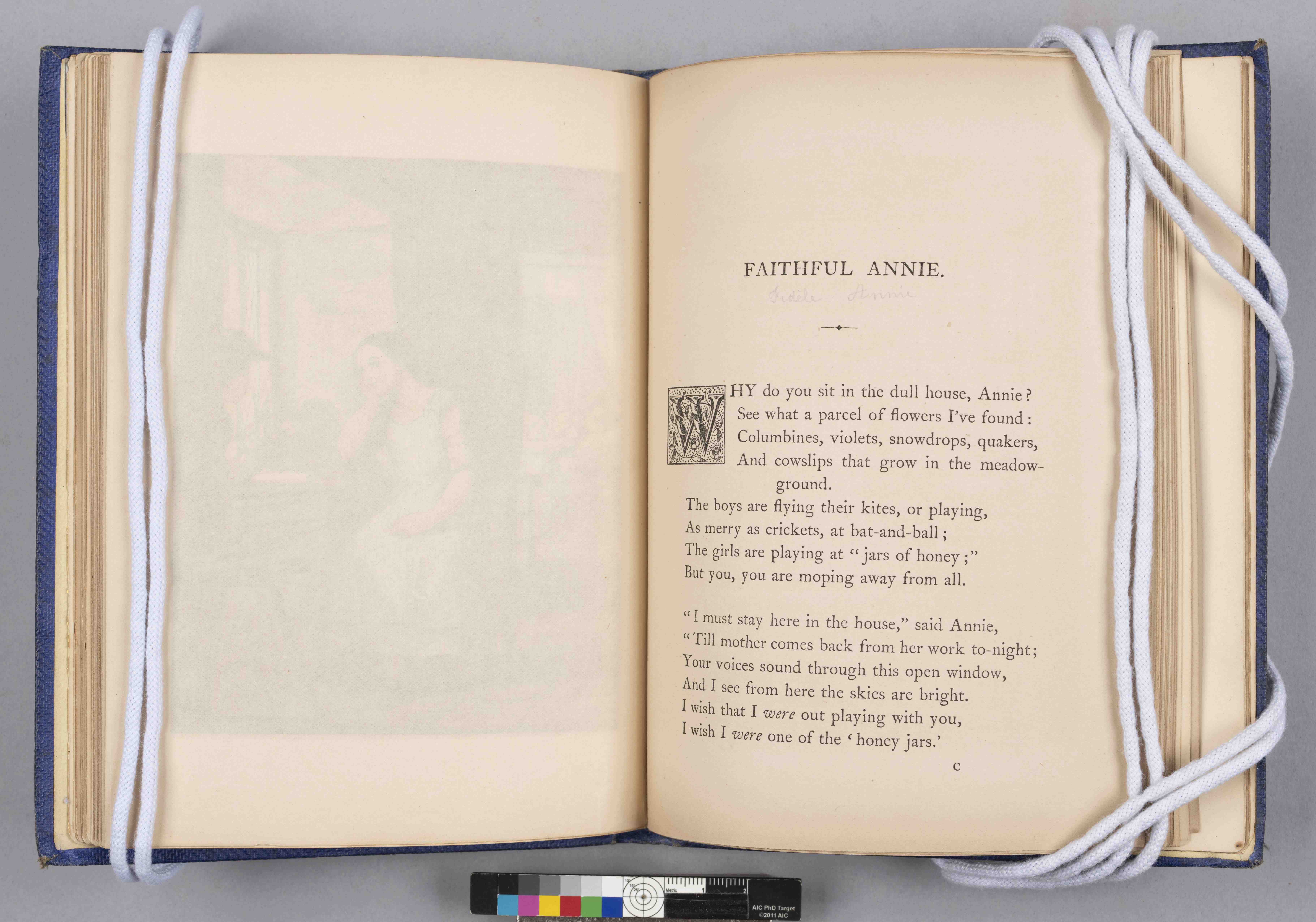
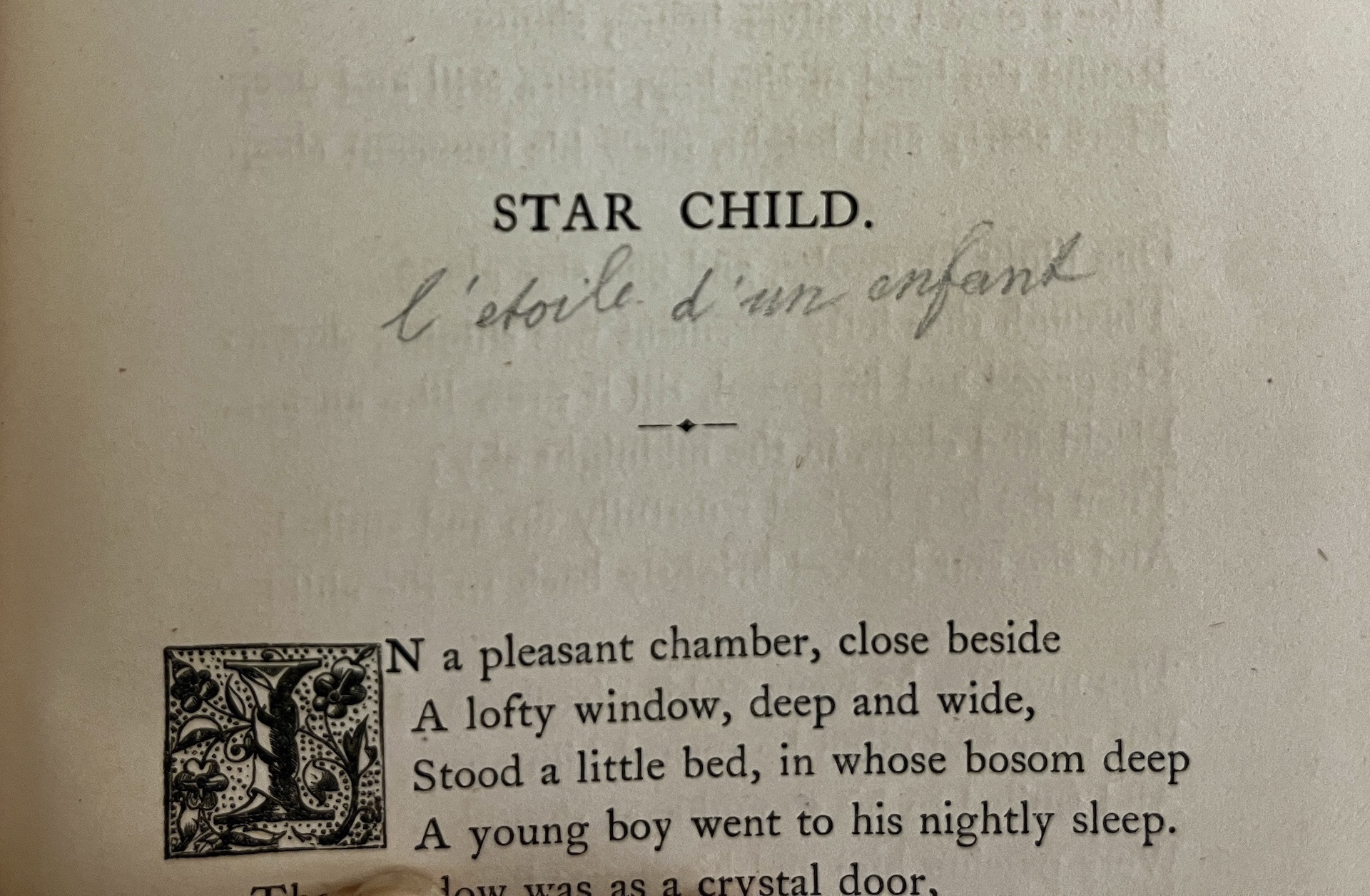
Although mass-produced, books like those in the Children’s Books Collection reward close looking. An endearing detail in Songs for the Little Ones at Home, which was published in London but sold in Paris, is that someone appears to have used the book to practice their language skills: each English poem title features a graphite translation to French.
More broadly, giftbook materiality reveals much about how industrialization and technological advancement allowed for greater accessibility to leisure goods.
As an early European application of natural rubber, patented two years before Goodyear’s vulcanization process, caoutchouc bindings prefigure the rubber boom that would support subsequent industrialization – for all its gifts and evils.
Additional Reading
American Institute for Conservation (AIC). "BPG Caoutchouc Bindings." AIC Wiki.(opens in a new tab) February 3, 2026.
Donovan, Sue. 2023. “Caoutchouc Bindings: The Origin and Application of a Rubber-Based Adhesive in Nineteenth-Century Gift Books.” In Suave Mechanicals: Essays on the History of Bookbinding, Vol. 8, Ed. Julia Miller. Ann Arbor, Mich.: The Legacy Press.
Frost, Gary. 1973. "Restoration of 19th Century Adhesive Bindings." Unpublished typescript.


